MSASI
MSASI is one of the key Science Instruments carried by the JAXA Mercury Magnetospheric Orbiter Spacecraft of the ESA / JAXA BepiColombo Mission to Mercury.
BepiColombo will elucidate the mysteries of MercuryBepiColombo is a Mercury exploration project jointly planned by Japan and the European Space Agency (ESA). The proximity of Mercury to the Sum makes it difficult to observe and hard to reach by space flight. Three passes by of NASA's Mariner 10 in 1974-75 have been the only exploration conducted so far.
The mission was inspired by the late Italian astrophysicist Dr. Giuseppe 'Bepi' Colombo, who suggested that a spacecraft could get close to Mercury several times by using a gravity-assist swing-by of Venus. Hence the name of the project, BepiColombo.
The Mariner 10 spacecraft revealed the presence of a magnetic field and magnetospheric activities in Mercury. BepiColombo will conduct comprehensive observations of Mercury's magnetic field, magnetosphere, and both its surface and interior. That will help determine how much it has in common with other planets, what elements are unique to Mercury as well as the origin and evolution of terrestrial planets.
Observation mission by BepiColomboThis project consists of two orbiters:
Mercury Planetary Orbiter (MPO) will observe the surface and interior;
Mercury Magnetospheric Orbiter (MMO) will observe the magnetic field and the magnetosphere.
The Japanese Space Agency JAXA is responsible for MMO, as Japan excels in the study of magnetic field and magnetospheres. The European Space Agency (ESA) is responsible for the launcher, the interplanetary cruising engine, the placement of BepiColombo into Mercury;s orbit, and the development of MPO.
BepiColombo was launched by an Arianne Rocket from Kurou in October 2018. After multiple planetary flybys, the MMO and MPO spacecraft will be inserted into their respective orbits around Mercury in November 2026.
MSASI
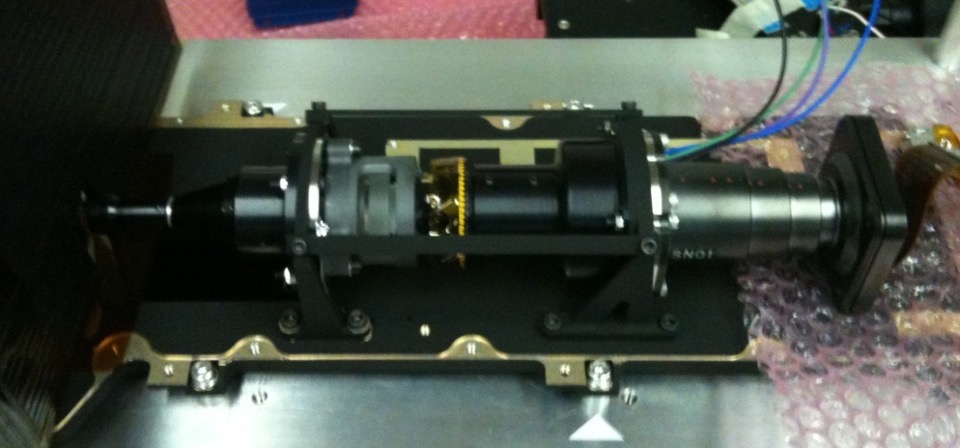
The Mercury's Sodium Atmosphere Spectral Imager (MSASI) on Bepi-Colombo is part of the Payload of MMO (JAXA) and will address a range of fundamental scientific questions pertaining to Mercury’s surface-bounded exosphere. The measurements will provide new information on regolith-exosphere-magnetosphere coupling as well as new understanding of the dynamics governing the exosphere bounded by the planetary surface, the solar wind and interplanetary space.
Ground-based observations indicate that Mercury’s regolith is continuously releasing gases into Mercury's exosphere. Sodium is perhaps the easiest of these to observe. Processes have been identified associated with different energies of ejection, behaviour in different regions of Mercury's surface and the ejection of different population types from the surface.
MSASI will image the 4-D structure of the sodium component of the exosphere, enabling detailed studies of the evolution of Mercury’s exosphere, including the ultimate loss of sodium via an anti-sunward tail that can be observed from the Earth.
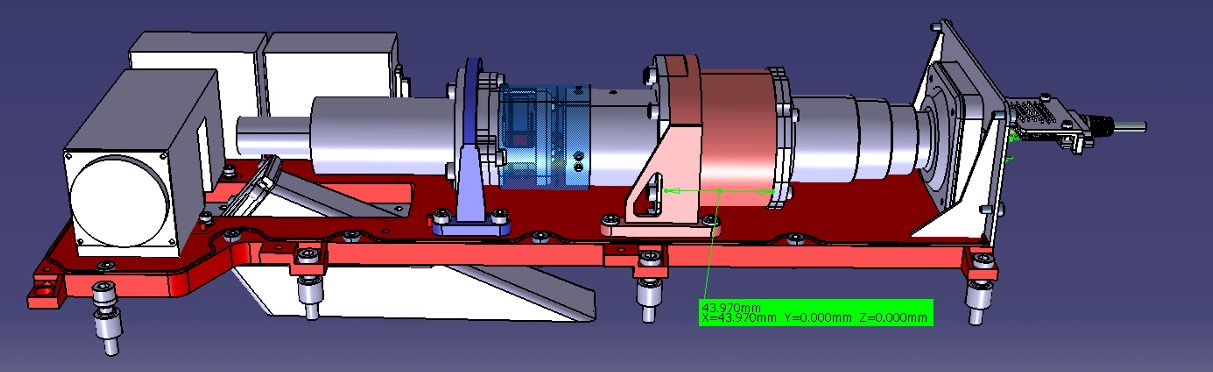
Key to MSASI
1: Scanning System
2: Collimation System
3: Filter and Fabry-Perot Etalon
4: Focussing System
5: Image Intensifier
6: Imaging System
7: CMOS Detector
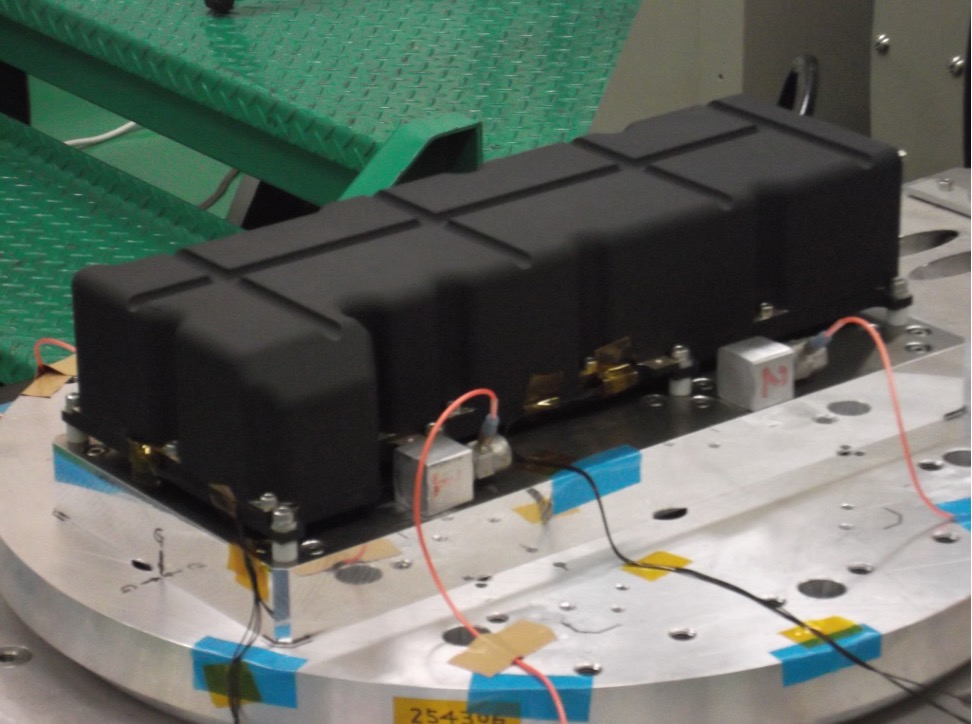
MSASI instrument on the Vibration Table in Japan following the final series of integration tests.
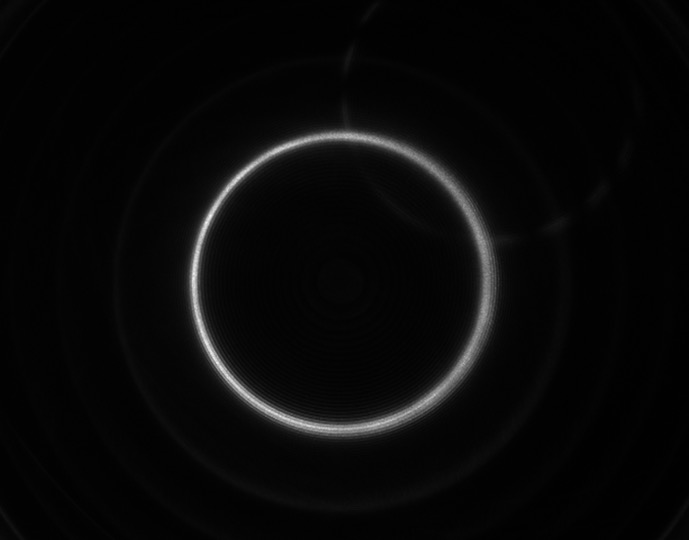
Typical Image Produced by MSASI
The Interference Filter and Fabry-Perot Etalon generate these circular fringe images by transmitting just one of the two Sodium 'D' lines.
Information from these fringes provides intensity, velocity and temperature information about the Sodium atoms allowing detailed studies of sources and the heating / acceleration mechanisms responsible for the 4-D distributions of sodium that are observed.